
Resuscitating Trout
A bad metaphor for special education

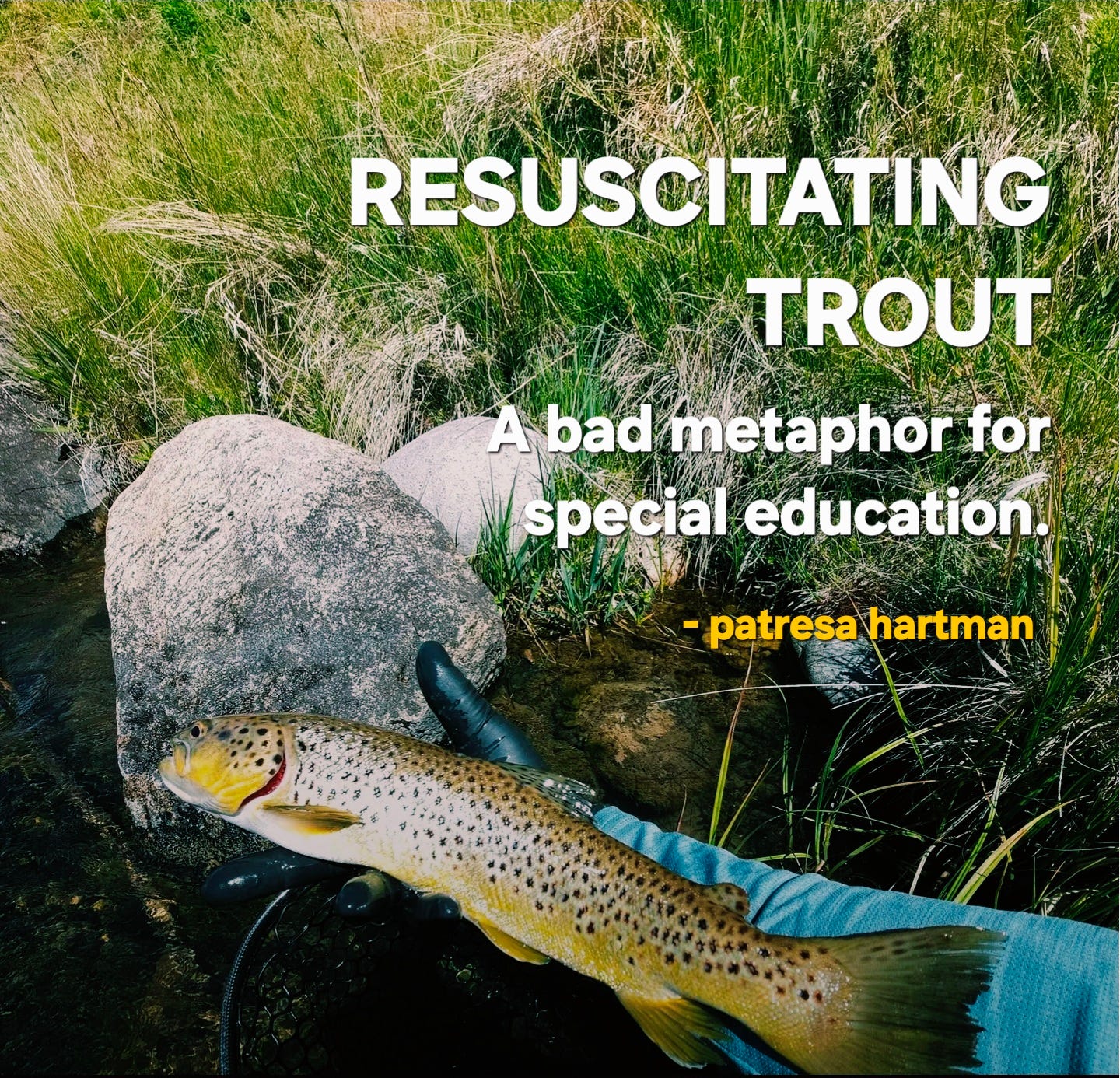
My cousin, Ryan Sherwood, is currently on a fishing trip in Montana. This is his photo and likely the reason for the following bad metaphor.
Today is the first day of summer break for me. I want to write about my job as a school psychologist for Iowa’s largest school district. I also worry about saying too much. So here is me trying to say enough without saying too much. I really want you to understand.
School psychologists work as part of a team of three (primarily), including a special education consultant and a school social worker. We are part of the Student and Family Services (SFS) department. We are assigned multiple schools, and we work mostly in special education. We work with special education staff to ensure programming needs are met; we do reevaluations to determine what new needs might arise; and we do initial evaluations to determine if there are disabilities that require special education services (and then help the team figure out what those services should look like).
In the past, we were more of a bridge between general education and special education. We helped more with the intervention process in an effort to meet a student’s needs in general education without needing to move toward special education. Special education in many ways, is a high-stakes decision for a young person. It can alter the course of their school career, which can impact what happens beyond high school. But as our resources grow less and we are spread thinner, we have been mostly scooted out of that intervention process.
Services happen along a spectrum. If you think of it like a river, everything upstream (universal, general education) impacts what happens downstream (in this metaphor: special education). It makes sense for us to put on waders and sample the waters in the upper and middle course. But we just don’t have the resources for that anymore. Now we hang out in the lower course with nets and tiny fish resuscitators and wonder why there are so many more struggling trout needing help.
(This metaphor really has a lot of problems. So many. Let’s not think about it too much.)
Anyway.
Special education consultants and school social workers usually have 2-3 schools. There are fewer school psychologists, and theoretically, our training includes both academics and behavior (I say theoretically, because it kind of depends on where we did our graduate studies and internships, and also everyone has different comfort levels.), so we fill the gaps.
Last year, we were short four psychologists, so we each had at least one extra school. I had four schools: 3 elementaries (Kindergarten/K-5th) and 1 Montessori (K-8th). A colleague was able to pull a report that showed that I did 60 initial evaluations across the year. This is just initial evaluations. It doesn’t count all of the reevaluations I did.
One year I had to do an initial evaluation in the summer. Because it was past contract days, I had to track my hours and bill the district. After meeting with the student two times at the public library, I clocked 9 hours to write the evaluation report. And that was a very basic evaluation – just reading and math for a student who is a native English speaker with no additional medical concerns, no transiency, no added complicating factors. Writing an initial evaluation report requires not just an analysis of the information you collect while assessing the student face-to-face, but it also includes interviews with teachers and parents, a review of historical testing data, and an analysis of their intervention progress monitoring. If it’s a student who is a Multilanguage Learner (MLL), you have to do an additional very tedious data analysis comparing their historical data to the historical data of other students who speak the same first language, are the same age, and have been in the country and the district for the same amount of time (a “true peer comparison”). We have a lot of MLLs in our district. Then, you synthesize all of that information to try to paint a coherent picture of the student, their patterns, and their needs and do it in a way that is helpful and usable by both teachers and families.
I’m not complaining about this. This is the part of my job that I like the most. It feels like detective work, and I feel like I have a particular knack for seeing how things connect. I take a lot of pride in my evaluations, as nerdy as that may sound.
And I’m not necessarily complaining about doing 60 of them, either. But speaking from a systems level: 60 across 4 schools is excessive, and it likely points to a significant problem further upstream that we are too stretched to address effectively. There shouldn’t be that many students whose needs aren’t being met in general education. There shouldn’t be this many struggling trout.
I need it to be very very clear that our district deals with a lot more environmental, socio-cultural factors than your typical Iowa district, which is at least partly why sometimes statewide measures that seem to make sense for smaller, more homogenous, districts, aren’t particularly helpful for us. Those factors MATTER.
That brings me to next year. Four of our school psychologists are leaving. We have no new hires. Next year, we will be short 8 school psychologists. Plus, our responsibilities for the private schools (booming, thanks to private school vouchers) have exploded. All of our assignments have expanded. I have been assigned 10 schools for the 2026-2027 school year.
TEN.
I’ll have 4 elementary schools, 1 middle school, 1 high school, and 4 private parochial schools.
This is not possible, and everyone knows it.
Our shrunken team of psychologists met with two members of the district admin who were part of making the assignments. In the most professional way possible, we asked, collectively, “What in the f–ing hell?”
They’re good people. They’re smart people. They know. And they did an exceptionally good job listening and taking notes. They are actively problem solving – how to team differently, which responsibilities to adjust (for everyone on the team), where to focus efforts and where to fade. Maybe it will help. Will it help enough? I don’t know how to change enough to make jumping from 4 schools to 10 not feel like a firehose in the face.
Not to mention… what happens to the students who need help but happen to be floating in the eddies where we have to fade services?
If you live around these parts, you might know that our district has been much and long beleaguered. We have a history of superintendents that get into hot water (Our most recent is sitting in federal prison.). This last year, multiple departments, including our own, have been audited by the state. As a result two of the departments within our SFS got completely cut. Wiped out. Positions eliminated. They created new ones in their place with different duties – not as many positions as we lost, and they’re paid less.
We are bugs under a magnifying glass. And, you know? Fine. Rightfully so. Yes, hold us and every other school (public and private) to account. Our role in preparing children to be productive members of society is massive and should have oversight.
The problem I have is this: WHEN YOU FIND PROBLEMS, HELP US FIX THEM.
You know what doesn’t help but seems to be the new American way for addressing problems with education? Tell us how much we suck and then take away funding so we have less and less ways to address those problems. Tell us to just figure it out. Watch us scramble around and try to “get creative” about how to do more with less. And continue to point and bitch when we still don’t measure up.
Man, I don’t know. If I’m going to die on a hill, it will probably be this one.
Patresa I love this so much! Your observations and commentary are brilliant. I did not know that you are responsible for private schools as well…everything is geared to funding these private schools at the expense of public education. Iowa used to be first in the nation in public education and it is so demoralizing (in a truly demoralizing world!) to watch this happen. I don’t know why people like you stay other than your integrity and commitment and compassion. Thank you for helping us understand what is happening. You are a saint💙
Thanks, Patresa, for:
Sharing your personal story so movingly.
Giving so much for kids, even when buffeted by severe headwinds.